

Hi friends,
You ever go on a road trip to the mountains, get food poisoning along the way, and keep going anyway while your kid fights herpangina, an ear infection, and teething so that you don’t get a full night’s sleep for four nights straight in a strange place? No? Well, in the words of Miss Clavel, “thank the Lord you are well.”

While I haven’t had much bandwidth for web reading the past few weeks, I’ve still managed to drum up some things that you’ll hopefully find interesting this weekend.
70s Sci-Fi Art is one of my favorite blogs, but it publishes so frequently that I struggle to keep up. I was glad not to miss its recent entry with Moebius’s illustrations of Dante’s Paradiso, as they are too good not to share.

Fr. Stephen Freeman writes about the ladder of daily life in a way that I think is encouraging. So much of contemporary life contends against the state of ordinariness. Career is the most notable example, with its metaphors of “climbing”, but parenting, politics, relationships, and almost any aspect of life are increasingly imbued with what David Zahl calls seculosity. But, the suspicion (fear?) of ordinariness is not an exclusively secular phenomenon. Whether through summons to a “radical” faith (remember that book??) among conservative Baptist-adjacent evangelicals of the mid-2000s, or the ever-growing politically-left inflected writings of “post-evangelical/ex-vangelical”s naively taking cues from liberation theology to deconstruct everything about western civilization, the instinct to reject just living a quiet, generous, productive, and loving life of worshiping at a local church, raising a family, and working a job seems a perennial temptation. There’s a lot I could write about how the New Testament’s writings were written prior to the emergence of a money economy, and how neglecting that fact leads to all sorts of confusion, but this bullet point is already running long.
From the blog: Recently graduated Cloudflarian Boris Tane wrote a prescient blog about the death of the software development lifecycle as we know it. I left a comment on a couple complications I see with this new paradigm that I’ll reproduce here, with some light edits:
Love this. It’s cogent and audacious — cogent because it’s a clear-eyed look at the current trajectory of things, and audacious because a lot of these practices still feel like sacred cows to me.
That said, the two wrinkles I could see in my crystal ball:
Accountability: if the agent handles everything, how do we contend with engineer accountability? Especially in the case of systems with a lot of legacy subservice dependencies, the sanity of the person holding the pager will be at risk (and their effectiveness limited) when agents don’t have consistent ready access to all system components. I think you got at this in the monitoring section, and until we have solid observability for agents to work with I think this will continue to be a bottleneck.
Economics: A lot of the changes we’re seeing (AFIU as of this writing) are predicated on the advancements of proprietary models (most people I talk with are heavy Opus users). Reliable agentic workflows lean heavily on the excellence of models served by privately held companies that can upend the cost/benefit analysis on a whim. I think quality open-source models that we can safely fall back on are going to be needed at some point.
The “economics” complication is already emerging since I wrote that comment, especially with Anthropic being designated a “supply-chain risk” by the DoW (a whole silly can of worms), and Anthropic taking legal action against OpenCode (N.B. I’m an OpenCode user and my money is on them in the long run).
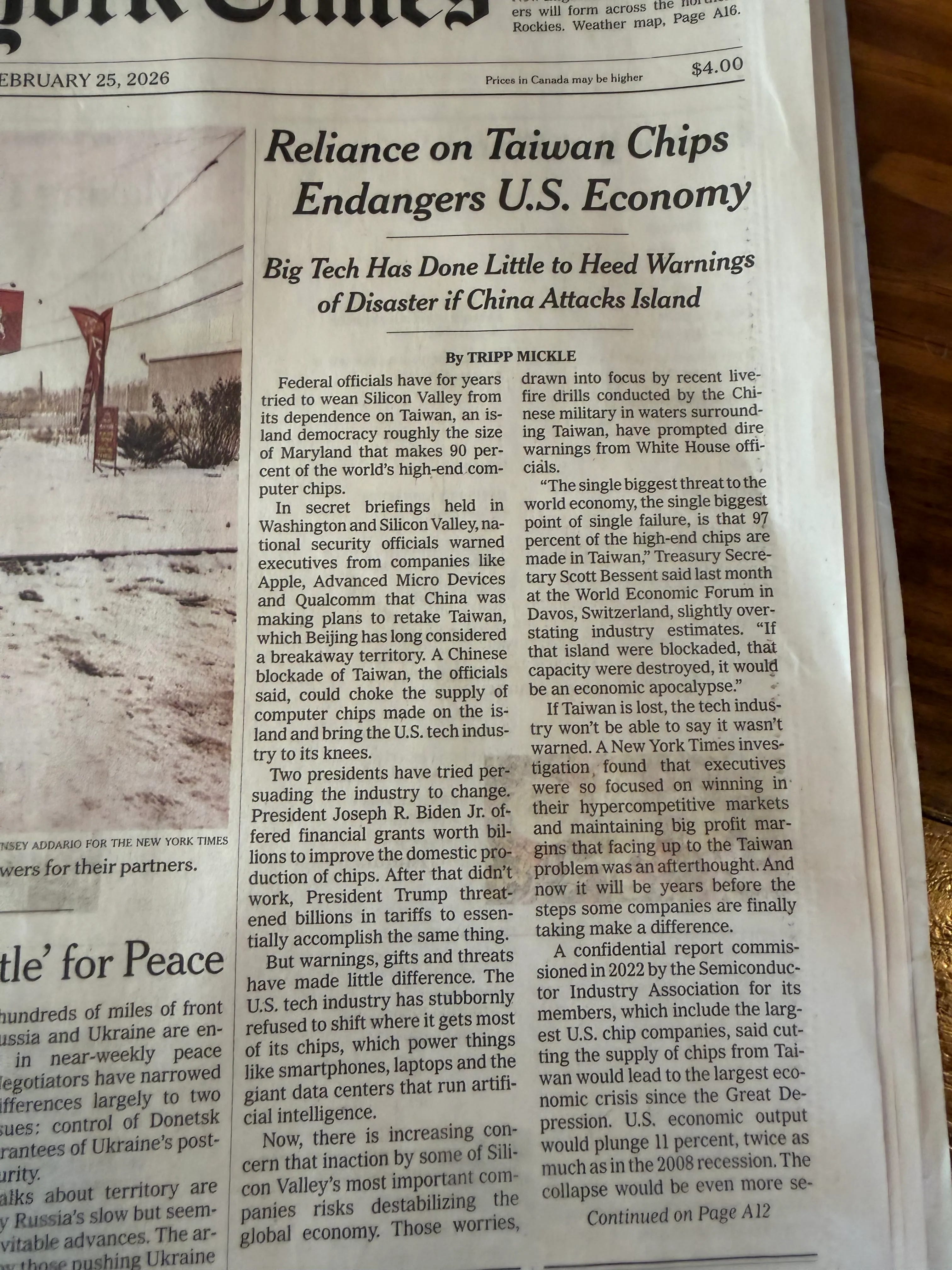
From the blog: While waiting for my espresso at Pinewood Coffee, I took a glance at the front page of the New York Times sitting on the counter, and saw this. Go ahead and read it:
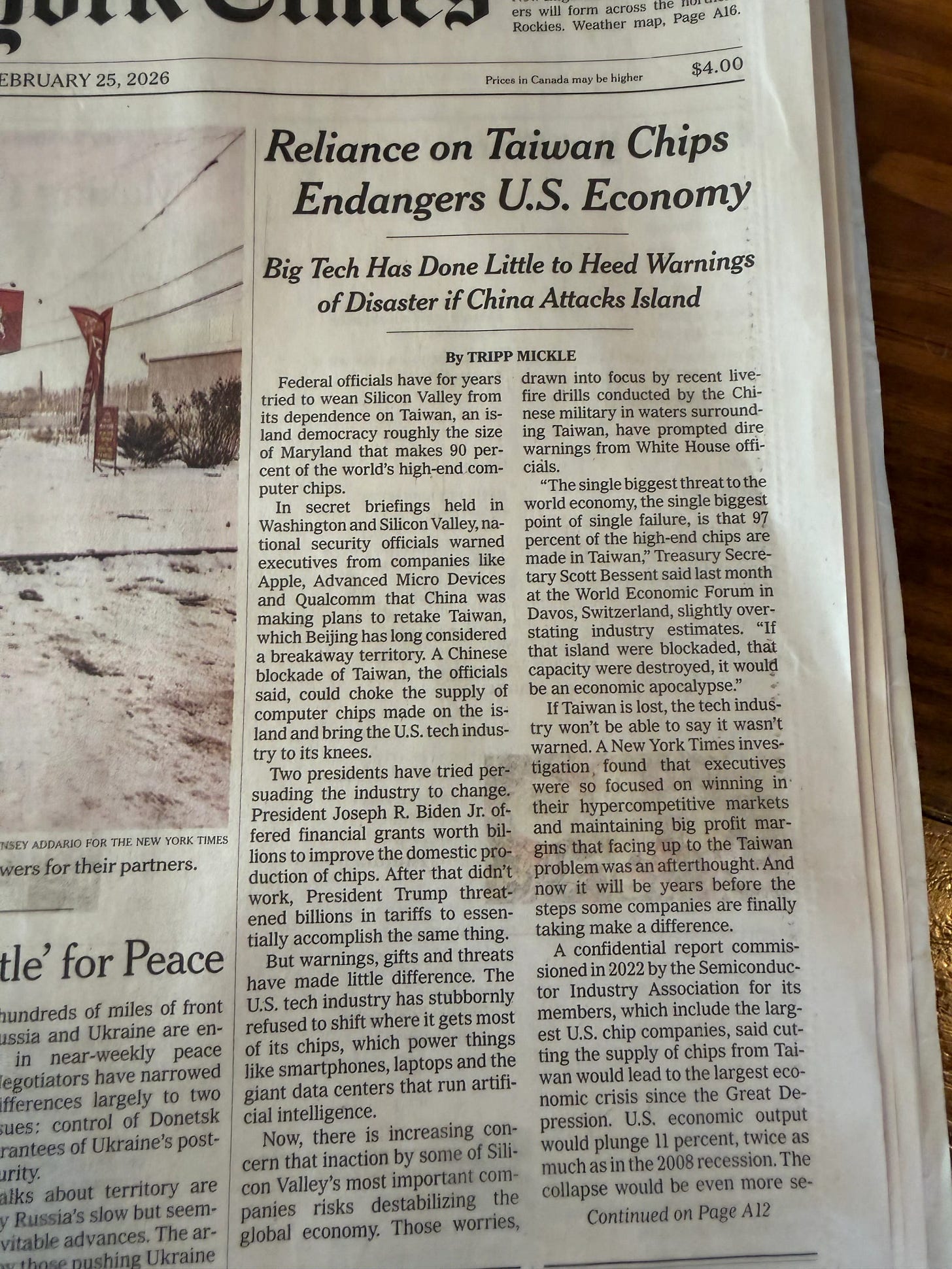
FWIW I still think print is GOATed. I did not turn the page, but nowhere in these first few paragraphs is any mention made of the fact that TSMC (the world’s largest semiconductor manufacturer, whose single largest shareholder is the government of Taiwan) has built a fab in Arizona thanks to U.S. incentives under the CHIPS act, for this exact reason. The same is true for Samsung building a semiconductor fab in Texas. Now, the fault may be mine for not finishing the article (my espresso was ready at this point), and I don’t have a Times subscription, but you would think that such significant data points in the narrative that this article is telling would make their way into the first eight paragraphs.
If you haven’t already, I highly recommend reading Chip War for a comprehensive history of how we got into this situation. What I find ironic, though, is that raising concerns around Chinese hegemony and wargaming near Taiwan, and suggesting that we repatriate our industrial/technological base as a hedge against the risks of globalization, has been labeled as “nationalistic” in the pages of the NYT and similar publications over the last decade.
Whether the cause is disingenuity, amnesia, or incompetence, it’s no surprise to me that public trust in the “fourth estate”, at least in its legacy institutions, continues to decline.
Alright, that’s enough for this Friday. It’s warm here in Central Texas, and I for one am happy to defrost a bit. Get outside, read a book, laugh with your kids, kiss your lover, have a drink too many with some friends if you safely can.
Cheers,
R
If you like 70s style sci-fi art, I think you'll love "Scavengers Reign" if animated shows are your thing!
Hoping the kiddos are better. Lots of good stuff here. Thanks for sharing.